-
 Getting Started
-
Sales Suite
-
Field Ops
-
Marketing
-
Service CRM
-
Developers
-
FloStack

Get Started

Sales Suite
Field Ops
Marketing
Service CRM
FloStack
Flostack Overview
1. Feature Overview
FloStack is a lead-qualification and routing layer that connects multiple lead intake channels to the right downstream conversion paths—such as personalized microsites, event microsites, and booking links.
It addresses the routing gap in acquisition workflows, where prospects arrive with intent, but neither they nor the organization can always determine the correct next step. Using lead context and decision rules, FloStack automatically guides each visitor to the appropriate content and action surface—whether that means speaking with an advisor, attending an event, or booking a meeting directly. This enables teams to scale qualified conversions without manual triaging or fragmented handoffs.
Why This Matters
In a typical customer-acquisition funnel, say for example, admissions:
- Visitors do not always know whether they should request counselling, register for an event, or directly book a meeting.
- Organizations struggle to direct leads to the correct next step without manual intervention.
- Teams often lack visibility into which leads have high intent and which ones require nurturing.
FloStack addresses this by using a decision-based architecture that automatically routes each lead to the correct experience. The goal is to eliminate ambiguity for both the prospect and the internal teams handling them.
Lead Intake Sources
FloStack accepts lead data from multiple online and offline entry points, including:
- Website forms
- Paid campaign landing pages (Google Ads, social channels)
- Lead-generation forms
- QR codes and walk-in registrations
- WhatsApp/SMS/chatbot responses
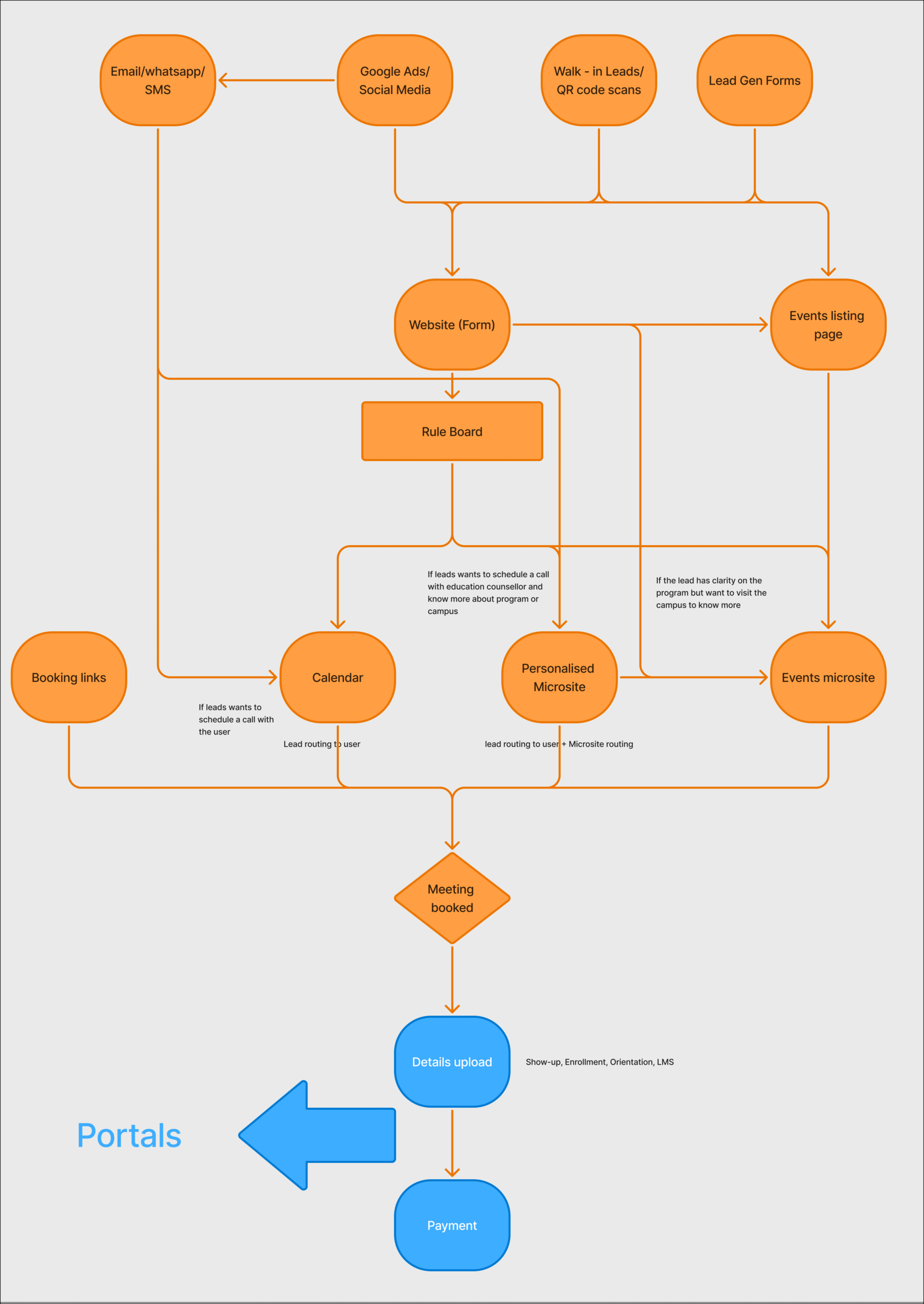
Each of these sources feeds into a central routing unit.
Rule Board (Decision Layer)
The Rule Board is responsible for determining the next step for every lead. It evaluates attributes such as:
- Lead source
- Program or course interest
- Location preferences
- Request for counselling vs self-service
- Intent to visit the campus or participate in an event
- Previous interactions
Based on rules and conditions, the Rule Board selects one of several conversion experiences.
Conversion Experiences
|
Experience Type |
Ideal Scenario |
Action Outcome |
|
Personalized Microsite |
Lead is exploring and requires information before speaking to an advisor |
Meeting booking via calendar |
|
Event Microsite / Events Listing Page |
Lead prefers attending an event or campus visit rather than requesting a call |
Event registration |
|
Direct Booking Links |
Lead is ready to speak immediately and does not require additional content |
Calendar booking |
Each experience provides structured information and CTAs suited to that specific stage of decision-making.
Post-Booking Workflow
Once the lead completes a booking or event registration:
- A Meeting booked status is generated.
- The booking is synced with downstream systems (CRM, LMS, payment systems, etc.).
- Post-booking steps can be triggered, including:
- Orientation information
- Details/document upload
- Payment or enrollment procedures
This ensures that the conversion journey continues after the initial booking.
End-to-End Flow Diagram
The following diagram illustrates the full routing and conversion workflow for a typical FloStack implementation: